
Papyrus Painting - Boats in Ancient Egypt Composite Scene
Product Description: Composite of 5 scenes of significance in ancient Egypt including the life of King Tut and the role of boats in Ancient Egypt in daily life and the afterlife. Natural background. All hand painted on papyrus.
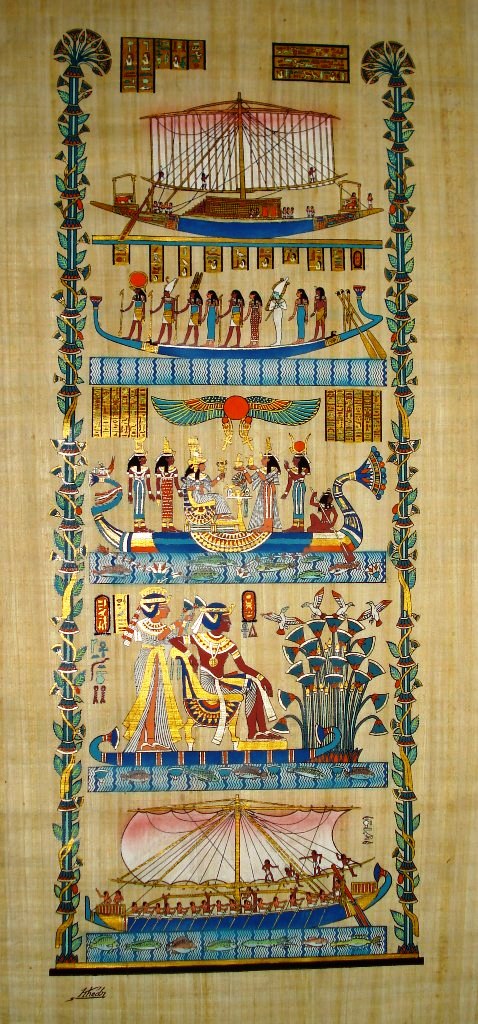
The top boat scene is taken from the tomb of Menna in Luxor. The Nile was both a problem and the main highway. Too wide to be bridged, the only way to carrying people and wares from one shore to the other. The wind blowing mostly from the North meant traveling between 40 and 70 kilometres a day. But in the event of no wind they carried quite large crews to row. The bottom boat is a fishing boat. The second scene show a solar boat, according to Egyptian beliefs, the soul of the dead accompanied the sun on its eternal journey in the Upper Waters (the heavens) around the world. A boat or at least a model of a boat was therefore included in every tomb. Some believe the wooden ship was a "solar boat" intended to be used by the deceased pharaoh in his eternal life as he journeyed across the sky from east to west to be united with the solar god Re. Another theory is that it was used as a funerary boat, to carry the body of the late pharaoh in his pilgrimage before burial in the pyramid. Scenes three and four show Nefertari, and King Tut respectively on boats on the Nile. The pharaohs prided themselves on their pleasure boats. And finally a fishing boat, the Nile the giver of life in all senses was abundant with fish.
All papyrus paintings are sent with "rough" edges, easily trimmed to fit
your framing needs.
*****NOTICE****
Changes implemented by the Ministry of Antiquities requires all papyrus
to be inspected by an expert - what this means is that while your order
will show as shipped, it may in fact be on hold at the Cairo airport
pending inspection. For this reason we are not able to combine papyrus
orders with anything else, i.e. papyrus and jewelry, or glassworks etc.
If you are ordering something else in addition to the papyrus you must
order it separately. We apologize for any delays that may occur,
ultimately it is about the preservation of the history of Egypt.
Artist: Khedr
100% Hand Painted
Available Sizes (Approx)
1" = 2.54 cm
60 x 130 cm (24" x 51") $140.00
|

Cairo, Giza, Pyramids Egypt Cairo Phone 011- 2-02-3780-6889 Mobile 011-2-02-012-233-4112 From Cairo with Love is a registered trademark. All rights reserved 2021. No part of these pages may be copied, reproduced or distributed without express written consent. |
