
Papyrus Painting - Marriage Ceremony of King Tut with a Dramatic Black Background
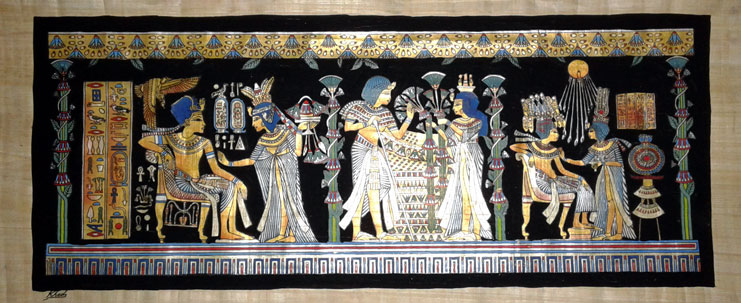
Product Description: Hand painted papyrus of King Tut's marriage with a black background. In ancient Egypt it was acceptable for royalty to marry within the family, probably in order to help preserve dynastic succession.
King Tut's predecessor Akhenaten and his queen, Nefertiti, had at least six children, but presumably no sons, as only girls are pictured in sculptures and reliefs of the family. This lack of boys in the main royal line (Akhenaten may have had a son or two, but by other, secondary, wives) made the question of dynastic succession a pressing problem. As a result it is believed that King Tut married his half sister Ankhesenpaaten, she later changed her name to Ankhesenamen, which means "She who lives through the Amun." Ankhesenamen was thirteen years old when she became the wife of Tutankhamun when he was only nine years old. The teenage queen apparently suffered two failed pregnancies: the miscarriage of a 5-month-old female fetus and a stillborn baby girl. (Both were mummified and buried in Tutankhamun's tomb.) In this papyrus scene starting from the left we see Ankhesenamen offering gifts to King Tut, she holds the lotus flower, the symbol of love. The center scene shows a mutual exchange around the lotus and finally we see the young Queen anointing Tut under the blessing of the Aten (sun).All papyrus paintings are sent with "rough" edges, easily trimmed to fit your framing needs.
*****NOTICE****
Changes implemented by the Ministry of Antiquities requires all papyrus to be
inspected by an expert - what this means is that while your order will show as
shipped, it may in fact be on hold at the Cairo airport pending inspection. For
this reason we are not able to combine papyrus orders with anything else, i.e.
papyrus and jewelry, or glassworks etc. If you are ordering something else in
addition to the papyrus you must order it separately. We apologize for any
delays that may occur, ultimately it is about the preservation of the history of
Egypt.
Artist: Khedr
100% Hand Painted
Available Sizes (Approx)
1" = 2.54 cm
80 x 30 cm (31" x 12") $95.00
130 x 60 cm (51" x 24") $145.00
|

Cairo, Giza, Pyramids Egypt Cairo Phone 011- 2-02-3780-6889 Mobile 011-2-02-012-233-4112 From Cairo with Love is a registered trademark. All rights reserved 2021. No part of these pages may be copied, reproduced or distributed without express written consent. |
