
Papyrus Painting - Full Final Judgment
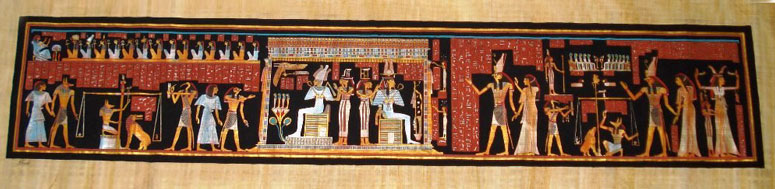
Product Description: Papyrus Painting. A rare depiction of the Final Judgment shows the journey to the after for both men and women. All hand painted, genuine papyrus.
This unique papyrus art shows the afterlife for men (left) and the afterlife journey for women(right). Here the deceased being lead by Anibus (the jackal) to the final judgment. (Perhaps because of a jackal's tendency to prowl around tombs, he became associated with the dead) Anubis was worshipped as the inventor of embalming, who had embalmed the dead Osiris, thus helping preserve him in order to live again. His task became to glorify and preserve all the dead. With Anibus leading, the deceased appears before a panel of 14 judges, depicted above him. It is here that he will make an accounting for his deeds during his life. The ankh, the key of life appears in the hands of some of the judges, note Anibus also holds the sacred ankh. Anibus is then charged with weighing the heart of the deceased in the left against the feather of Ma'at, the goddess of truth and justice in the right tray. If the heart of the deceased outweighs the feather, then it is a heart which has been made heavy with evil deeds and his ultimate fate would be meeting the god Ammit, the god with the crocodile head and hippopotamus legs will devour the heart, thus condemning the deceased to oblivion for eternity. But if the feather outweighs the heart and the deceased has led a righteous life he is presented to Osiris, the judge of the dead. Thoth, the ibis-headed god of wisdom stands ready to record the outcome. Horus, the god with the falcon head, who is also carrying the ankh, will lead him to Osiris. Osiris, is shown wearing the crown of Lower Egypt, the north. He holds the symbols of Egyptian kingship in his hands - the shepherd's crook to symbolize his role as the shepherd of mankind, and the flail, representing is ability to separate the wheat from the chaff. The sacred lotus flower is in front of his throne. The Eye of Horus is holding the outcome of the deceased's life. Behind him stands his wife Isis, and her sister Nephthys. Together they welcome the deceased to the underworld.
All papyrus paintings are sent with "rough" edges, easily trimmed to fit
your framing needs.
*****NOTICE****
Changes implemented by the Ministry of Antiquities requires all papyrus
to be inspected by an expert - what this means is that while your order
will show as shipped, it may in fact be on hold at the Cairo airport
pending inspection. For this reason we are not able to combine papyrus
orders with anything else, i.e. papyrus and jewelry, or glassworks etc.
If you are ordering something else in addition to the papyrus you must
order it separately. We apologize for any delays that may occur,
ultimately it is about the preservation of the history of Egypt.
Artist: Khedr
100% Hand Painted
Available Sizes (Approx)
1" = 2.54 cm
200 x 50 cm (79" x 20") $325.00
|

Cairo, Giza, Pyramids Egypt Cairo Phone 011- 2-02-3780-6889 Mobile 011-2-02-012-233-4112 From Cairo with Love is a registered trademark. All rights reserved 2021. No part of these pages may be copied, reproduced or distributed without express written consent. |
